




Yamaha vs Kawai piano comparison
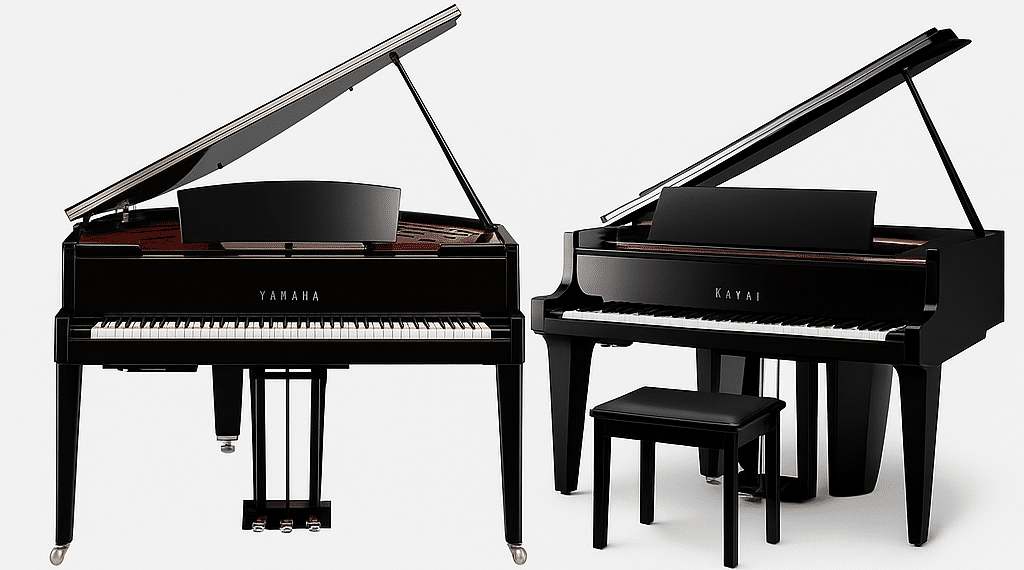
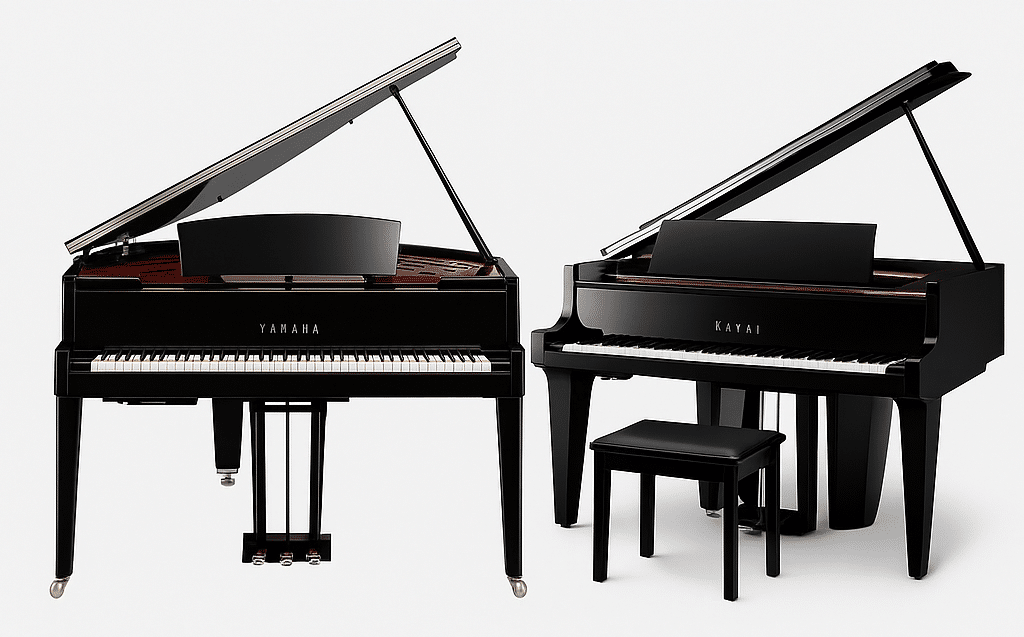
Yamaha And Kawaii They are among the most reputable Japanese piano manufacturers. Both brands offer grand pianos ranging from compact models for private use to professional instruments suitable for conservatories, studios, and concert halls.
However, a pianist hesitating between a Yamaha or Kawai grand piano will quickly discover differences in touch, design, and sonic personality.
SO, Yamaha or Kawai: which brand to choose? Let's compare their main product ranges and their most interesting models.
Yamaha vs Kawai: the comparison in brief
| Criteria | Yamaha | Kawaii |
|---|---|---|
| Origin | Japan | Japan |
| Iconic compact model | GB1K | GL-10 |
| Length | 151 cm | 153 cm |
| Professional range | CX Series | GX Series |
| Iconic mid-range model | C3X – 186 cm | GX-3 – 188 cm |
| Mechanical | Yamaha Mechanics | Millennium III |
| Sound quality* | Clear, precise, definite | Often perceived as rounder and warmer |
| Use | Very versatile | Very versatile |
| For a living room | Excellent | Excellent |
| Studio / Conservatory | Excellent | Excellent |
*The perception of timbre remains subjective and varies from one instrument to another. Therefore, a real-world test should take precedence over a brand's reputation.
Yamaha: precision and versatility
Yamaha offers a particularly wide range of grand pianos.
For small spaces, the GB1K It measures only 151 cm and weighs 261 kg. Yamaha presents it as its most compact grand piano; it is made in Indonesia.
Above these are, in particular, the GC and CX series.
There CX series This constitutes a particularly interesting range for advanced and professional pianists. Yamaha explains that it has incorporated construction principles from its CFX concert grand piano into certain models, particularly for the soundboard.
Kawai: touch and rich sound
Kawaii also owns several families of grand pianos.
The series GL constitutes the entry point, notably with the 153 cm GL-10. Kawai presents it as a "baby grand" designed to easily integrate into a room. The series GX The range increases and includes the GX-1, GX-2, GX-3, GX-5, GX-6, and GX-7. These instruments use mechanical Millennium III and the GX are manufactured at the Kawai factory in Ryuyo, Japan.
At the top are the prestigious Shigeru Kawai.
Yamaha GB1K vs Kawai GL-10: which one to choose for a living room?
This is probably the most interesting duel for someone looking for a small grand piano.
The Yamaha GB1K measures 151 cm compared to 153 cm for the Kawai GL-10. The Yamaha weighs 261 kg compared to 282 kg for the Kawai. Both have 88 keys and three pedals.
| Yamaha GB1K | Kawai GL-10 | |
|---|---|---|
| Length | 151 cm | 153 cm |
| Width | 146 cm | 150 cm |
| Height | 99 cm | 102 cm |
| Weight | 261 kg | 282 kg |
| Keys | 88 | 88 |
| Pedals | 3 | 3 |
| Profile | Yamaha Compact Piano | Baby grand Kawai |
However, the choice should not be limited to dimensions.
Choose the Yamaha GB1K instead. if you are looking for an extremely compact piano and appreciate the Yamaha touch and personality.
Choose the Kawai GL-10 instead. whether you prefer the feel of its Millennium III mechanism or the sound character of the Kawai tested.
Yamaha C3X vs Kawai GX-3: the big duel
For a more experienced pianist, the comparison between the Yamaha C3X and the Kawai GX-3.
They are almost exactly the same size.
The Yamaha C3X measures 186 cm and weighs 320 kg. The Kawai GX-3 measures 188 cm for 334 kg.
| Yamaha C3X | Kawai GX-3 | |
|---|---|---|
| Length | 186 cm | 188 cm |
| Width | 149 cm | 152 cm |
| Height | 101 cm | 102 cm |
| Weight | 320 kg | 334 kg |
| Range | CX | GX |
| Profile | Advanced / Professional | Advanced / Professional |
| Use | House, conservatory, studio | House, conservatory, studio |
The GX-3 uses mechanical Millennium III, A solid spruce soundboard and hammers with felt underlays. Yamaha, for its part, has notably reinforced the bracing of the C3X and uses a manufacturing method for its soundboard inspired by the CFX in order to improve projection and response.
This comparison C3X vs GX-3 This could eventually become a dedicated article on Grand-Piano.eu.
What is the difference in sound between Yamaha and Kawai?
This is probably the most delicate question.
Yamahas are often described as offering a sound:
- clear ;
- accurate ;
- bright ;
- well defined.
Kawaii characters, on the other hand, are frequently associated with a particular character:
- rounder; ;
- warm ;
- soft ;
- rich in the medium.
But we must be careful with these descriptions.
Two acoustic pianos of the same model can have differences, and the acoustics of the room, the tuning and especially the voicing of the hammers considerably alter the perception of the timbre.
It would therefore be excessive to claim that Yamaha is consistently brilliant and Kawai consistently warm.
For a major purchase, listen to both instruments under conditions as similar as possible.
And what about touch?
This is another factor that could tip the scales in the decision.
Kawai uses its own mechanics on its GL and GX series. Millennium III.
Yamaha develops its own mechanics and places particular emphasis on the responsiveness and expressiveness of its professional series.
Here again, no chart can replace a test.
One pianist may immediately prefer the feel of a Kawai while another will be more comfortable on a Yamaha.
Try, in particular:
- rapid repetitions; ;
- the pianissimos; ;
- powerful chords; ;
- trills; ;
- the control of nuances.
Yamaha or Kawai for start ?
For a first grand piano, both manufacturers are interesting.
THE Yamaha GB1K and the Kawai GL-10 allow access to a real grand piano while limiting the footprint.
However, it is not necessarily necessary to buy new.
Given a budget, a second-hand Yamaha or Kawai of a higher range can sometimes be a more attractive choice than a small new piano.
Which product ranges should be compared?
To help you with your search, here are some interesting matches:
| Need | Yamaha | Kawaii |
|---|---|---|
| Very compact | GB1K | GL-10 |
| Small grand piano | C1X / GC1 | GL / GX-1 |
| Intermediate | C2X | GX-2 |
| Studio / Conservatory | C3X | GX-3 |
| Large professional model | C5X / C6X / C7X | GX-5 / GX-6 / GX-7 |
| Very high-end | SX / CFX | Shigeru Kawai |
These are not strict equivalencies, but rather models to consider when comparing the two catalogues.
Yamaha vs Kawai: Advantages and disadvantages
| Yamaha | Kawaii |
|---|---|
| ✅ Very wide selection of models | ✅ Very wide selection as well |
| ✅ Excellent reputation for reliability | ✅ Distinctive Millennium III mechanism |
| ✅ Highly versatile CX series | ✅ GL and GX series are very consistent |
| ✅ Extremely compact GB1K | ✅ GL-10 very interesting for a living room |
| ✅ C3X versatile reference | ✅ GX-3, a very serious direct competitor |
| ❌ Some pianists may prefer a less bright tone | ❌ Network and availability vary depending on the market |
| ❌ Higher-end series become expensive | ❌ Higher-end series also become expensive |
So, Yamaha or Kawasaki?
There is no absolute winner.
Yamaha will be particularly interesting for the pianist seeking great versatility, excellent precision and an extremely wide range.
Kawaii It deserves to be favored by those who particularly appreciate its Millennium III mechanics and the sonic personality of its instruments.
For a living room, the duel GB1K vs GL-10 deserves a comparative listening.
For an advanced pianist, the duel C3X vs GX-3 is even more interesting.
In all cases, an acoustic piano must be tried before buying. Technical specifications allow you to pre-select models; they do not allow you to determine which one will give you the best experience.